Checked
About Brampton, Ontario: a newcomer and visitor guide
Brampton, Ontario, Canada
What to know about Brampton, Ontario: where it is, its 2021 population of 656,480, growth, neighbourhoods, Brampton Transit and Züm, major employers, climate, languages, hospitals, schools and landmarks.
Key information
Brampton is a fast-growing city of 656,480 people (2021 Census) northwest of Toronto, in the Region of Peel. Once a farm and greenhouse town that grew much of Canada's cut flowers, it is now one of the country's most diverse cities and home to the team that runs Canadarm2.
On this page
Where is Brampton?
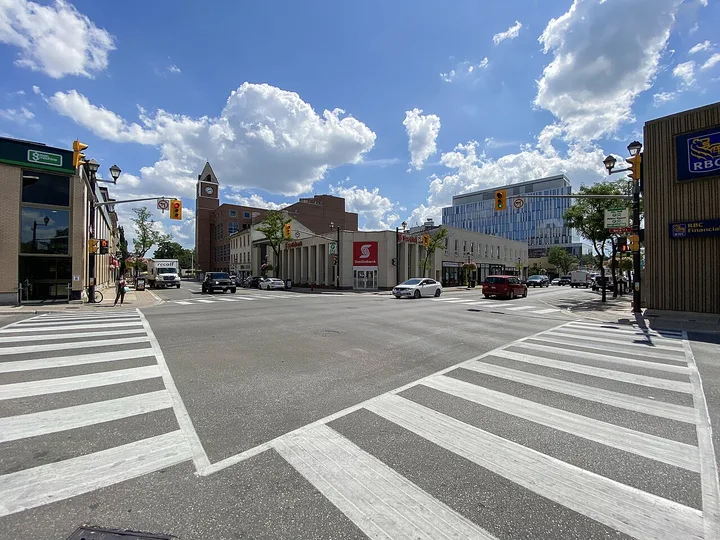
Brampton is northwest of Toronto, between Mississauga to the south and the Town of Caledon to the north. It covers 265.89 square kilometres of land in the Credit and Humber river watersheds. The original village grew up where Hurontario (Main) Street meets Queen Street, beside Etobicoke Creek.
Brampton is one of three municipalities in the Region of Peel, with Mississauga and Caledon. The City runs transit, recreation, parks, libraries and local roads. The Region runs water, waste, public health, paramedics and social housing. Some regional services are moving to the City (see the section on regional changes below).
Sources: Statistics Canada: Census Profile, 2021 Census, Brampton (City) · The Canadian Encyclopedia: Brampton · City of Brampton: Province announces changes to key public works in Brampton (December 13, 2024)
What is the population of Brampton?
- 2001341,463 people
- 2006456,114 people
- 2011542,697 people
- 2016615,190 people
- 2021687,462 people
- 2025777,759 people
The 2021 Census counted 656,480 people in Brampton, up 10.6 per cent from 593,638 in 2016. The Canadian Encyclopedia ranks it as Canada's ninth-largest city by census count. Brampton is young: the median age was 36.0, and the average household had 3.6 people.
Statistics Canada's estimate for July 1, 2025 is 777,759. Estimates are adjusted for people the census missed, so they run higher than census counts. The City's economic development office describes a population of about 800,000.
Sources: Statistics Canada: Census Profile, 2021 Census, Brampton (City) · Statistics Canada: Population estimates, July 1, by census subdivision (Table 17-10-0155-01) · The Canadian Encyclopedia: Brampton · Invest Brampton: Economic Development Office
Who lives in Brampton? Languages and backgrounds
| Measure | Brampton, 2021 |
|---|---|
| Immigrants | 343,690 people (52.9 per cent of people in private households) |
| Visible minority population | 523,850 (80.6 per cent) |
| South Asian | 340,815 (52.4 per cent) |
| Black | 85,310 (13.1 per cent) |
| Most common mother tongues | English (279,415) and Punjabi (141,005) |
| Other common mother tongues | Gujarati (22,000), Urdu (21,945), Hindi (19,645), Tamil (14,030) |
| Can speak neither English nor French | 31,675 people |
| Indigenous identity | 3,255 people |
| Homes owned | 78.1 per cent of households |
Brampton had the second-largest Sikh population of any Canadian city in 2021, after Surrey, British Columbia.
Sources: Statistics Canada: Census Profile, 2021 Census, Brampton (City) · The Canadian Encyclopedia: Brampton
Main areas and neighbourhoods
Brampton has 10 wards. Voters elect a mayor, five regional councillors and five city councillors, and each councillor serves a pair of wards.
- Downtown Brampton: the old village around Main Street and Queen Street, home to PAMA and the historic Main Street South area.
- Bramalea: in the east, planned in the late 1950s as a separate "satellite city"; its first houses were built in 1959.
- Mount Pleasant: a newer "urban transit village" built around a GO station and a rebuilt 1902 railway station.
- Older hamlets now inside the city: Churchville, Huttonville, Snelgrove, Castlemore, Mayfield, Nortonville and Stanley's Mills.
- Heart Lake: the area around Heart Lake Conservation Area.
Sources: City of Brampton: Brampton City Council 2026-2030 · The Canadian Encyclopedia: Brampton · City of Brampton: CPR Station
How do people get around Brampton?
Most people drive. In the 2021 Census, 85.9 per cent of Brampton commuters went to work by car, truck or van and 10.3 per cent used public transit.
Brampton Transit runs 70 routes with 516 buses. Five of them are Züm rapid bus lines (Queen, Main, Steeles, Bovaird and Queen West), with limited stops and transit signal priority. Züm links to the Mount Pleasant, Lisgar and Malton GO stations, York University, Humber College and Mississauga City Centre. The busiest route is 501 Züm Queen.
The Hazel McCallion Line light rail, now under construction, will run 18 kilometres from Port Credit GO in Mississauga to the Brampton Gateway Terminal at Steeles Avenue. In August 2026 Metrolinx would not give an opening date.
Sources: Statistics Canada: Census Profile, 2021 Census, Brampton (City) · Brampton Transit: Fast facts · Brampton Transit: About Züm · insauga: Construction on Hazel McCallion LRT to continue into 2027 (August 12, 2026)
Economy and major employers
| Employer | What they do in Brampton | Full-time staff |
|---|---|---|
| Amazon | Fulfilment and distribution centre | 6,500 |
| Rogers Communications | Corporate campus (former Nortel head office) | 5,200 |
| Stellantis | Automobile assembly plant (activity paused) | 3,521 |
| Loblaw Companies | Head office | 3,200 |
| Canadian Tire | Warehouse and distribution centre | 2,690 |
| MDA Space | Global headquarters, space robotics | 1,000 |
Invest Brampton counts more than 122,000 businesses in the city. Main sectors include advanced manufacturing, logistics, food processing, health and life sciences, and space, defence and cybersecurity.
MDA Space has its global headquarters in Brampton, including a space robotics mission control centre. The Brampton office operates Canadarm2 and Dextre on the International Space Station. Loblaw Companies has its head office in the city. Activity at the Stellantis assembly plant, which built the Dodge Charger and Challenger, is paused while the company reassesses its North American plans.
Sources: Invest Brampton: Economic Development Office · Invest Brampton: Research and data, Brampton's top employers · Invest Brampton: Space, defence and cybersecurity · Invest Brampton: Advanced manufacturing · The Canadian Encyclopedia: Brampton
What is the weather like in Brampton?
| Measure | Value |
|---|---|
| January average temperature | -5.5 °C (average low -9.4 °C) |
| July average temperature | 21.5 °C (average high 27.1 °C) |
| Rain per year | 681.6 mm |
| Snow per year | 108.5 cm |
| Days above 30 °C | About 16 a year |
| Frost-free season | About 168 days |
Brampton has cold, snowy winters and warm summers. The nearest long-term weather station is at Toronto Pearson Airport, just south of the city in Mississauga.
Hospitals, colleges and universities
- Brampton Civic Hospital (William Osler Health System), 2100 Bovaird Drive East, opened in 2007. Osler says it is among the busiest hospitals in Ontario, with one of the highest emergency department volumes and one of the largest labour and delivery programs in the province.
- Toronto Metropolitan University School of Medicine opened in Brampton in July 2025 in the former Bramalea Civic Centre, with its first MD students arriving that September.
- Sheridan College's Davis Campus, 7899 McLaughlin Road, is Sheridan's largest campus, with about 8,900 full-time students in health, community services, engineering and technology.
- Algoma University has a campus in downtown Brampton.
- Health811, finding a family doctor and urgent care in Brampton
- How to register for school with the Peel boards in Brampton
Sources: William Osler Health System: Brampton Civic Hospital · Toronto Metropolitan University: School of Medicine, our journey · Sheridan College: Davis Campus (Brampton) · Algoma University: Brampton campus
Landmarks and what Brampton is known for
- Flowers: in the 1920s, nearly half of Canada's cut flowers came from Brampton's Dale Estate greenhouses.
- PAMA (Peel Art Gallery, Museum + Archives): in the Peel County Courthouse and Jail, both opened in 1867.
- The Rose Theatre and Gage Park.
- Chinguacousy Park, Professor's Lake and Heart Lake Conservation Area.
- Historic Bovaird House, a mid-19th-century Georgian farmhouse (closed while the City prepares to reopen it).
- Sport: the Brampton Excelsiors lacrosse club, formed in 1871, has won the Mann Cup 11 times.
Sources: The Canadian Encyclopedia: Brampton · PAMA: History · City of Brampton: Historic Bovaird House
Brampton and the Region of Peel: what is changing
In 2023 the province planned to dissolve the Region of Peel. In December 2023 it changed course: Peel stays, and some services move to the cities instead.
Since July 1, 2024, the City of Brampton, not the Region, has been responsible for land use planning in Brampton. The Peel Transition Implementation Act, 2025 received Royal Assent on December 11, 2025. It moves regional roads and their stormwater systems, and waste collection, from the Region to Brampton, Mississauga and Caledon.
In its December 2025 decision, the province said it intends to set the dates by regulation: July 1, 2027 for regional roads and October 1, 2027 for waste collection. Until then the Region keeps doing this work. Water, public health, paramedics and housing stay with the Region.
Sources: Region of Peel: Provincial review update · City of Brampton: Province announces changes to key public works in Brampton (December 13, 2024) · Environmental Registry of Ontario: Peel Transition Implementation Act, 2025, decision (ERO 025-0570)
Questions and answers
What is the population of Brampton?
The 2021 Census counted 656,480 people. Statistics Canada's estimate for July 1, 2025 is 777,759, which includes an adjustment for people the census missed.
Source: Statistics Canada: Census Profile, 2021 Census, Brampton (City)
Is Brampton part of Toronto?
No. Brampton is a separate city northwest of Toronto, in the Region of Peel with Mississauga and Caledon.
What is Brampton known for?
Its fast growth and diversity, its history of flower greenhouses, the Brampton Excelsiors lacrosse club, and MDA Space, which operates Canadarm2 from the city.
Was Brampton famous for growing flowers?
Yes. In the 1920s nearly half of Canada's cut flowers came from the Dale Estate greenhouses in Brampton. The business closed in 1980.
How many wards does Brampton have?
Ten. Councillors each represent a pair of wards, and the city also elects a mayor.
What languages are spoken in Brampton?
English is the most common mother tongue, followed by Punjabi (141,005 people in 2021), Gujarati, Urdu, Hindi and Tamil.
Source: Statistics Canada: Census Profile, 2021 Census, Brampton (City)
What is Züm in Brampton?
Züm is Brampton Transit's bus rapid transit service, launched in 2010, with five limited-stop routes on major roads.
Source: Brampton Transit: Fast facts
Which hospital serves Brampton?
Brampton Civic Hospital, run by William Osler Health System, is the city's full-service hospital. It opened in 2007.
Source: William Osler Health System: Brampton Civic Hospital
Does Brampton have a medical school?
Yes. Toronto Metropolitan University's School of Medicine opened in Brampton in 2025.
Source: Toronto Metropolitan University: School of Medicine, our journey
How cold does Brampton get in winter?
January averages -5.5 °C at nearby Pearson Airport, with average lows of -9.4 °C and about 108 cm of snow a year.